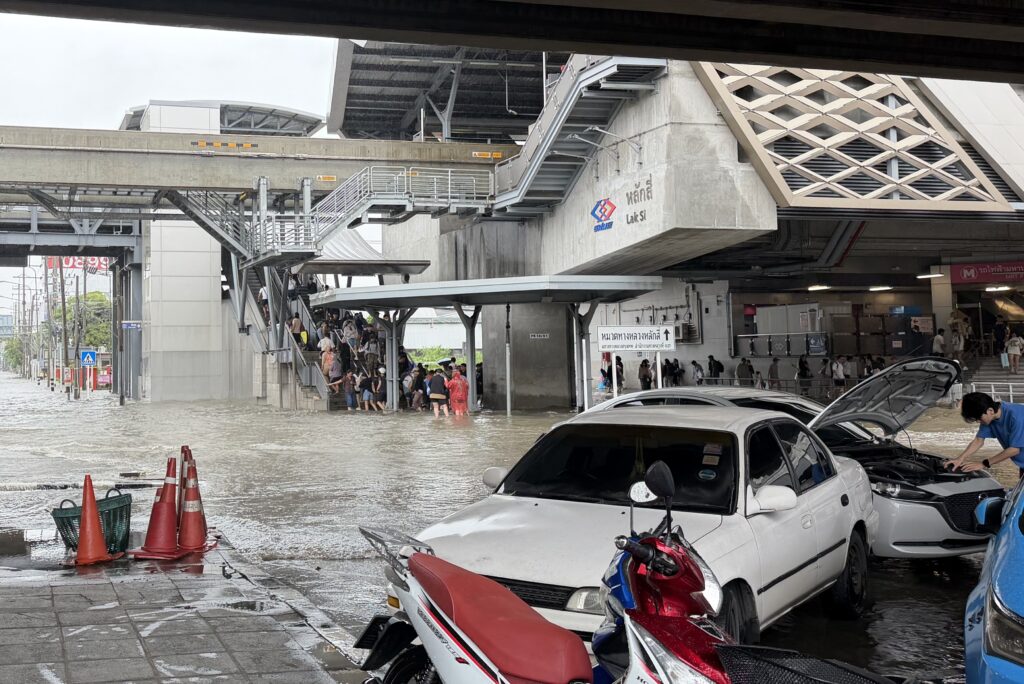
The Bank of Thailand is watching the economic effects of persistent flooding in Bangkok and neighbouring provinces, but says it cannot yet put a firm figure on the damage because the waters have not receded.
Chayawadee Chai-Anant, the central bank’s assistant governor for corporate relations and spokesperson, told reporters on 1 October that the first effects were concentrated in services. Transport, the distribution of goods, retail and wholesale businesses had been disrupted, and some construction sites had been suspended temporarily. Small and medium-sized firms and small traders had seen damaged stock, weaker spending and more difficulty servicing debt.
The impact on tourism had so far remained limited, she said, unless water levels rose further and flooding spread more widely. Manufacturing had not reported severe damage to factories or industrial estates.
“At this stage, we cannot yet put a figure on the impact on gross domestic product because the situation is still ongoing and needs to be monitored closely,” Ms Chayawadee said. She added that various estimates had put property damage at around 0.03 to 0.1 per cent of GDP, though some of that might later be offset by repair and reconstruction. Whether growth for the year would fall below the Bank of Thailand’s forecast would have to be judged with other factors.
The central bank has told financial institutions to speed up help for borrowers affected by the floods. Sixteen institutions — ten commercial banks and six specialised financial institutions — have offered measures such as holidays on principal or interest payments, lower instalments, longer repayment periods and reduced interest rates, as well as emergency loans, home-repair loans and working capital for smaller firms.
The flooding is not expected to disrupt Thailand’s hosting of the 2026 Annual Meetings of the International Monetary Fund and the World Bank Group, scheduled for 12 to 18 October in Bangkok. A business continuity plan is in place, and the conference area and venues used by participants within a five-kilometre radius were not expected to be affected, provided upstream water is managed and there is no substantial further rain.
Separately, the Bank of Thailand said the economy had been broadly stable in August. Thailand welcomed 2.5 million foreign tourists that month, up 1.8 per cent from July, though tourism receipts were unchanged as the average length of stay declined. Headline inflation rose to 2.53 per cent, from 1.95 per cent a month earlier, driven by higher fresh food and energy prices. The bank said it would continue to watch the floods, among other risks, as the recovery remains uneven.
The Bank of Thailand’s 1 October briefing concerned persistent flooding in Bangkok and neighbouring provinces, and the central bank’s inability at that point to put a firm figure on GDP. It should not be read as a flood warning for Hua Hin. Separate official notices issued for this coast, including a September flood watch for Hua Hin, Pranburi and four other Prachuap districts and later beach red-flag and heavy-rain reporting, are local or provincial warnings, not the same event as the Bangkok-area flooding the central bank was discussing.
Ms Chayawadee said the first economic effects were in services, that tourism had so far remained limited unless flooding spread more widely, and that estimates of property damage around 0.03 to 0.1 per cent of GDP might later be offset by repair work. Those figures were given as estimates, not as a final national total. We have not added a later GDP revision, because none was in the sources used here. IMF meetings, which she said remained on track, are likewise a separate official timetable, not a local Hua Hin event.
Sources:
- The Nation (1 October 2026)